< back to WilliamT fitness
Helpful hints
This page includes information of a variety of fitness and exercise topics. These hints are referenced in other exercise and combo pages.
These helpful hints are big enough to have their own page.
- Apps that I like, apps.htm
- Book recommendations, books.htm
- Fitness links, fitness_links.htm
- Hypertrophy hints, hypertrophy.htm
- NASM expert fitness advice, nasm.htm
- Products that I use, products.htm
- Weight loss hints, weight_loss.htm
Helpful hints aren't listed in any particular order. Go!
-
It's almost universal. One of the biggest workout hurdles we face is just getting to the gym. It's the endless, internal debate that so many of us have: do you want to go, do you have time, whatever. [#hurdle]
You can win this debate by 1) recognizing that it exists and is ubiquitous, and 2) reminding yourself (your brain) that you'll feel great once you're there and getting 'er done. You own your workout and will decide what you do every day. So, if you're lagging, then do a slow, easy workout. Chat someone up. Walk.
-
Add turbo power to your cardio by changing speeds. Every 2-3 minutes, increase your intensity for about 30 seconds. Sprint if you can. Then, resume your normal, aerobic pace to recover. Rinse and repeat throughout your whole exercise. This is a simple way to make cardio fun while increasing the benefits of what you're doing. [#turbo_cardio]
The technical term for this style of exercise is interval training. Here's a good overview from VeryWellFit, www.verywellfit.com/interval- training-workouts-3120774
Other cardio ideas: 1) Fiddle with all the different types of cardio, and 2) If you're having a good day, then cardio longer. If not, then shorter.
- Walking is working out. So is walking the dog. So is a bike ride. Outdoor fitness is great for both your physical and mental health. [#walking]
-
Squats are an important exercise. You shouldn't have knee pain/stress when squatting. If you do, stop...and get some help from your favorite fitness trainer. [#squats]
Important things to remember: 1) Bend at the waist, and 2) Keep your knees behind your toes. This "trick" makes your glutes and thighs do the work, not your knees.
This video reinforces the "knees stay behind toes" mantra, www.youtube.com/watch?v=aclHkVaku9U
- Print a monthly calendar and put it on your fridge. Then, fill in your workouts as they happen each day. This is old school, but it really works for me. [#calendar]
-
Your "core" includes your abs, lower back, glutes, and hip muscles. The "core" is synonymous with the "Lumbo-Pelvic-Hip Complex" (LPHC). Your core muscles are critically important to your strength and stability because they connect your torso to legs. [#core]
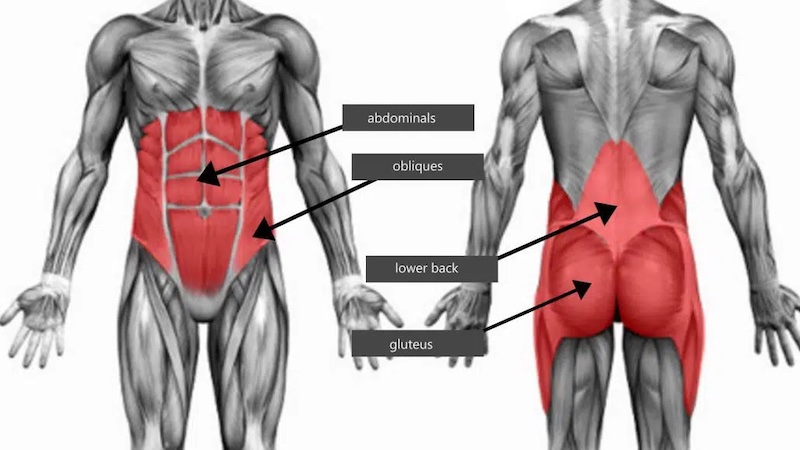
Source: www.evergreenclinic.ca/5-best-core-exercises-for-beginners -
About deadlifts. What's the difference between a (regular, old) deadlift and a Romanian deadlift? [#deadlift]
- A traditional deadlift is like a squat; you can bend your knees.
- In a Romanian deadlift, keep your knees straight (but not locked) and bend at the hip, like a hip hinge.
Here's a nice description with examples, www.healthline.com/health/romanian-deadlift-vs-deadlift.
-
A 4/2/1 tempo to an exercise slows the reps down to give a more difficult, and rewarding, workout.
The 4/2/1 numbers mean: 4 seconds to load, 2 seconds to pause, and then 1 second to perform the exercise.
For example, a dumbbell curl at 4/2/1 tempo takes 4 seconds to bring the dumbbell down, then a 2 second pause, followed by a strong 1 second curl.
[#tempo421]
- NASM definition: "Tempo of movement during Phase 1 is set at a slower 4/2/1 pace. This means that it is 4 seconds for the eccentric contraction, 2 seconds for the isometric hold, and 1 second for the concentric contraction. By utilizing slower eccentric and isometric actions, more demand is focused on the connective tissue and stabilizing muscles, preparing the nervous system for future functional movements."
- Here's an example of a 4/2/1 tempo bench press, www.youtube.com/watch?v=Fq8iST7OXnA
- Example squat at 4/2/1 tempo, www.youtube.com/watch?v=G1I4DOwVkcw
- For fun: "A 2019 study also found that people who can do 40 push-ups have fewer cardiovascular disease events than those who cannot complete 10 push-ups", www.verywellfit.com/the-push-up-exercise-3120574 [#pushups40]
-
Running on the treadmill is ok. Running races is FUN! [#run5k]
Running a 5K race is a great place to start. They're 3.1 miles, and it doesn't take a lot of training to make this happen.
The Hal Higdon website is a great place for training advice on everything from a 5K to a marathon, www.halhigdon.com/training/5k-training
Article: "The Joyful Stride: Unveiling the 10 Comprehensive Benefits of Running", www.active.com/running/articles/10-benefits-of-running
-
VeryWellFit: "Delayed onset muscle soreness (DOMS) is a phenomenon in which muscle pain or stiffness develops a day or two after exercise." [#doms]
These articles explain DOMS and share ideas on how to deal with it.
- VeryWellFit article: "Understanding Delayed Onset Muscle Soreness (DOMS)", www.verywellfit.com/muscle-pain-and-soreness-after-exercise-3119254
- NASM Article: "Muscle Soreness and DOMS", blog.nasm.org/doms-muscle-sorenes
-
This article by TomsGuide is an interesting discussion of high reps vs heavy weights in resistance training. Article: "High reps vs heavy weights: which is better for building muscle?", www.tomsguide.com/face-off/high-reps-vs-heavy-weights-which-is-better-for-building-muscle [#reps_vs_weight]
Here are the TomsGuide recommendations for different training goals:
- Strength + endurance - "High rep ranges (above 12) with much lighter weights and less rest are known to improve muscular endurance by working muscles continuously..."
- Weight loss - "If you’re lifting for a higher volume of reps for longer, you’re more likely to burn calories. After exercise, your body will consume more oxygen to rebalance your body, increasing your metabolism."
- Max strength - "Lifting heavy weights for fewer reps (around 2-6) and higher sets (4-6) with rest periods of a few minutes is the preferred method for strength training programs. You’ll lift heavier weights close to your one rep max (1RM), which means choosing weights you could only manage a few reps at a time."
- Hypertrophy (getting bigger) - "...hypertrophy training sits in the middle — around 3-4 sets of 8-12 reps of an exercise with 30-60 seconds of rest between sets. Hypertrophy requires lifting at a percentage of your 1RM, but as you close out the final reps, you should be reaching failure."
The BIG finale: "Either way, the best way to encourage adaptation is through consistency and challenge, whether training for muscular growth, improving endurance, or building strength."
-
Injury or age can make getting up/down to the floor (or yoga mat) a difficult task. [#safely_get_up]
Here are some instructions to help you do this.
- Article: "How to Safely Get up and Down From the Floor" by VeryWellFit, www.verywellfit.com/how-to-safely-get-up-and-down-from-the-floor-1230957
- Video: "Getting Up Off the Floor Correctly" by AskDoctorJo, www.youtube.com/watch?v=lwVhl04v0E4
-
Glutes are a key part of many exercises: squat, lunge, deadlift, leg press, etc. It's important to train your body to use your glutes during those exercises. [#glutes]
The three largest muscles in your body: 3) Deltoid (shoulder), 2) Gluteus maximus (glutes), and 1) Quadriceps femoris (quad/thigh)
Article: "10 Largest Muscles in the Human Body", largest.org/people/muscles-in-the-human-body
-
The debate rages on: weight machines vs free weights. [#machines_vs_free_weights]
The cool kids don't like machines. My two cents: whatever.
Article: Here's a good discussion of this debate, "Are Free Weights Better Than Weight Machines?" by VeryWellFit, www.verywellfit.com/free-weights-vs-machines-3119446
Mostly, it's important to understand the advantages and disadvantage of each. Many people use a combination of these two fitness tools. I agree with the conclusion in the VeryWellFit article above: "Ultimately, the right balance comes down to your personal preference."
-
VeryWellFit: "A superset is a form of strength training in which you move quickly from one exercise to a different exercise without taking a break for rest between the two exercises.
...during supersets, you move from one set to another without a break. A shorter exercise session can lead to muscle, cardiac, and other health gains." [#supersets]Article: "Supersets in Strength Training", www.verywellfit.com/what-is-a-superset-3120397
-
The main thing about stretching: It feels great! [#about_stretching]
For the best results: Slow down. Breath deep. Be calm and focused.
With a little practice, you can turn your stretching time into a wonderful fortress of solitude.It's often recommended that we hold a stretch for 30 seconds. Indeed, 30 seconds isn't chosen out of thin air, there's a physiological reason for it, www.hopkinswellness.com/blog/whats-the-big-deal-with-holding-stretches-for-at-least-30-seconds
Now, most of us don't have the time or patience to spend 30 seconds on each stretch. And that's fine. I shoot for about 10 seconds on most stretches. So, maybe 30 seconds is a little better, but a 10 second stretch is WAY better than not stretching at all.
-
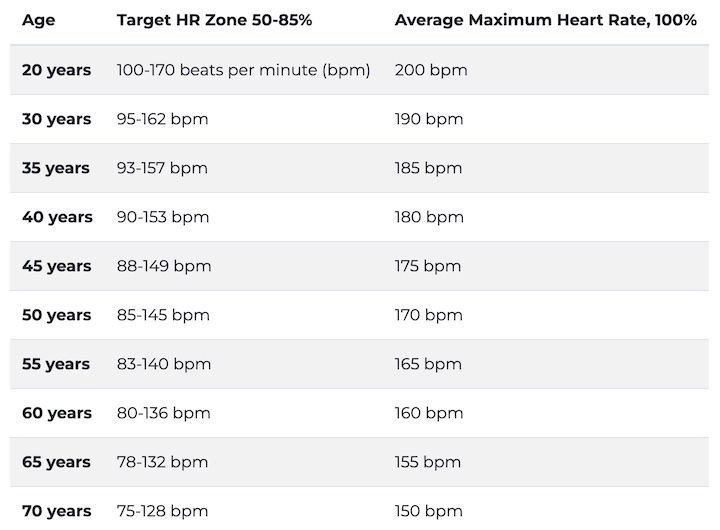
Target and max hearts rates, courtesy the American Heart Association, www.heart.org/en/healthy-living/fitness/fitness-basics/target-heart-rates [#heart_rate]
I purchased a watch with a heart rate monitor for workouts with members.
You can read more here, products.htm